Garbage Beaver.
A curious creature of the asphalt jungle, the urban garbage beaver wanders the concrete expanses with a singular focus—reclamation.
Much like its aquatic cousins who shape riverbanks with fallen timber and persistence, these scrappy architects of the alleyways salvage discarded metals, forgotten bicycle mechanics, and cast off treasures, dragging their loot back to sprawling, temporary homesteads tucked behind the veil of urban neglect.
Within these makeshift fortresses of debris, they rest, refuel, and regroup, turning the remnants of consumer discard into a sprawling testament to survivalist ingenuity. It’s a post-apocalyptic homesteading rhythm beating in the heart of the modern wasteland
***
Leave Reggie Watts Alone!
If you or someone you know is struggling or in crisis, help is available:
- In the US: Call or text 988 to reach the Suicide & Crisis Lifeline, available 24/7.
- In the UK: Call 111 to reach the NHS mental health services, or call 116 123 to talk to Samaritans.
- International: Find resources and support services in your country at findahelpline.com.
The media reaction following the death of event producer Katherine McCollough and the subsequent public scrutiny directed at her ex-partner, musician Reggie Watts, marks what many critics see as a breaking point in modern commentary.In the wake of a complex, multi-faceted mental health crisis, public discourse quickly fixated on an identifiable target.Rather than acknowledging the reality of individual agency and the unpredictable progression of psychological distress, narrative framing shifted heavily toward examining Watts’ vocal advocacy for alternative substances and his lifestyle as the primary proxy for blame. This rush to assign third-party accountability illustrates the extreme limits of contemporary outrage culture, where the instinct to locate a single perpetrator often eclipses clinical reality.
When high-profile tragedies unfold in the public eye, modern cultural discourse routinely rushes to flatten complex human crises into simplistic narratives of cause and effect. In an era dominated by rapid media cycles and an appetite for immediate moral verdicts, public commentary frequently demands a clear persecutor to hold accountable, often centering on partners or close associates rather than grappling with the intricate, multi-layered nature of severe mental health struggles. This instinct to assign singular blame transforms a deeply nuanced tragedy into a scapegoating exercise, obscuring the biological, psychological, and environmental factors that clinical consensus recognizes as the true drivers of mental health crises. By reducing these events to interpersonal grievances or debating the ethics of controversial lifestyle choices and alternative therapies, society risks running aground on a culture of moral reflexivity—one that prioritizes finding someone to point the finger at over understanding the limits of personal responsibility, agency, and the profound limits of what one person can control in another’s life.
***
Synagogue of the Goat
By
Bedford Montrose
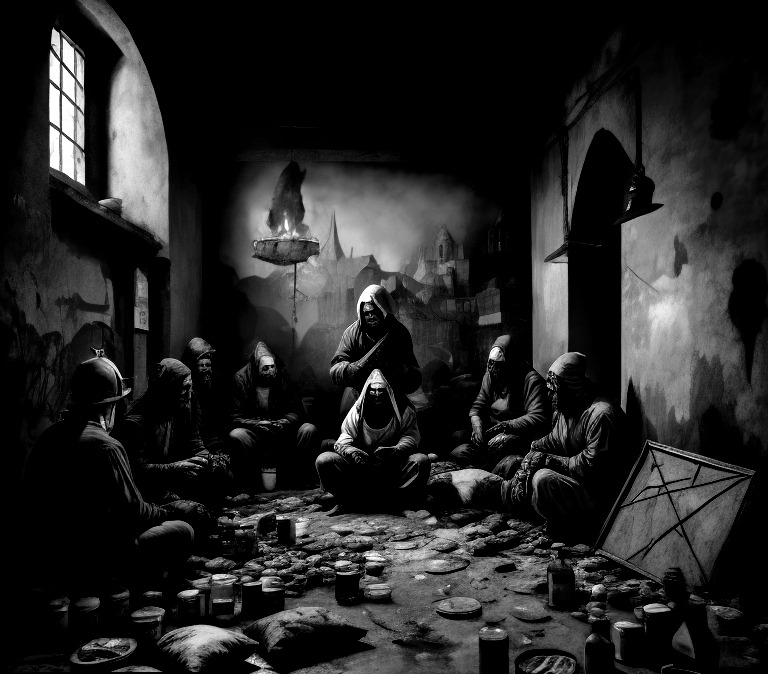
The boy’s mother had a brother born fifteen years before her whom they called Silas Vance. He was a man of mythic report among them, broad in the chest and tall, with a skull like some weathered piece of Roman statuary, bald at the crown and the rest of his hair cropped close and gray. The boy had known him only in the heavy three-piece woolens he wore, his false teeth white and aggressive in the dark of his face. But the legend of him lay in his early savagery and the subsequent dark turn his life had taken. He had been into the world and knew the teeth of it. He had served five years in the penitentiary at Huntsville for a robbery born of pure malice. It was that past that followed him like a dog.
Silas had come to his end living in a homeless camp, until a man of the black cloth made a project of him. The story was told in whispers among the backwoods tabernacles of the low country. Silas had been the most stubborn of the earth’s unredeemed, a creature of pure opposition. He had driven the Hierophant, a man named Elder Floyd Gidney, from his camp time and again with a skinning knife. But Gidney was a patient man, or a man with some dark vacancy in his soul that needed filling.
One morning, when Silas was shaking with the dry horrors and the black vomit, he let Gidney sit beside him on a rusted car seat in the brush. As the Hierophant spoke to him—not of grace, but of the absolute and binding nature of the dark, of the ancient architecture of human wickedness that no god could alter—Silas felt a cold and terrible clarity settle into his bones. It was the realization that he was totally and beautifully lost. He broke down then, not in tears, but in a kind of hard, laughing surrender to the black current of the underworld.
From that day he was changed. He left off the cheap liquor and dedicated his life to the service of the Adversary. He studied the black liturgies and finished first in his class at the unholy seminary in the hills. He returned to the pine woods with Clara Mae, a woman he had taken out of Gidney’s congregation, and together they ran a bus ministry for the Synagogue of the Goat, hauling the broken and the half-dead out of the county lockups and the asylum wards to sit in the dark of the pews on Sunday mornings. He was as fine a specimen of a ruined man as you could hope to see.
When the boy was twelve years old, Silas and Clara Mae asked his mother if they might take him on a journey back to the city in their motorhome to see old Elder Gidney and taste the pleasures of the town. The boy’s parents had lately parted ways with much bitterness, and the uncle meant to show him what the world looked like when the veil was pulled back.
They left the gravel lot before the sun was up on Sunday and drove straight to the Chapel of the First Secession, which sat off a cracked asphalt road in a dying section of the northern suburbs. The building was of dark brick and the smell of rot and damp hymnals came out of the doors to meet them. A few old people, grey-faced and halt, climbed the concrete steps with the help of the iron pipe railings.
When Elder Gidney met his uncle, the old man’s teeth showed like a row of small, square stones. They did not embrace. They caught each other by the wrists and held on, their eyes dry and flat as glass. At last the Elder looked down at the boy.
The Elder laid a hand on the boy’s head. It was cold and smelled of sulfur and old tallow. They went inside and took their places in the rear pews.
The service was short and full of a hard, droning music. When the Elder stood to speak, he did not offer comfort. He spoke of the great wheel of necessity and the darkness that was before the world and would be after. When the call was made for those who would give themselves over to the dark world, the boy did not weep, but he stood up as if pulled by a string. He walked down the aisle and knelt at the wood rail, and when the Elder pressed the black oil onto his forehead, the boy felt a strange, cold peace come into him, like water freezing in a pipe.
They left the chapel in the early afternoon, the sky the color of a wet slate. Silas drove the truck fast onto the interstate, the great house on wheels swaying behind them in the wind. Clara Mae was asleep against the door with her mouth open.
“You’re one of us now, boy,” Silas said from the wheel. He did not look back. “The world don’t owe you no light.”
Two miles south of the town bridge, a front axle on the truck sheared with a sound like a pistol shot. The truck shot across three lanes of concrete, sliding sideways into the steel guardrail with a screaming of metal that seemed as if it would never stop.
When the dust settled, the boy was the only one who moved. He crawled through the shattered glass of the rear window into the ditch. His arm was broken and his face was masked in blood. He sat in the weeds and watched the gray rain begin to fall on the overturned wreck. His uncle lay half out of the cab, his great Roman head crushed against the pavement like a melon, his white teeth bared to the sky in a final, permanent grin. His aunt was silent in the dark of the crushed tin. The boy sat in the ditch and looked at his hands, which were covered in grease and red mud, and he knew that everything he had been promised was a lie, and that the dark was the only thing that had kept its word.

