“Paradise often bares the seeds of its own demise”
The only thing truly weird left in this town is the cold arithmetic of survival. They talk about keeping it weird, but the reality on the ground is an abundance of twenty-dollar burritos, seven-dollar cold brews, and rent prices inflated to a level that leaves zero room for the real line-crossers, the genuine outsiders, the true weirdos—not the weekend hobbyists playing dress-up in vintage gear when it’s convenient. The rest of us don’t have time to perform on command; we’re stuck on the hamster wheel, grinding out hours just to cover the cost of existing, left with no energy for anything else when we aren’t pissing and moaning about our dwindling bank accounts.
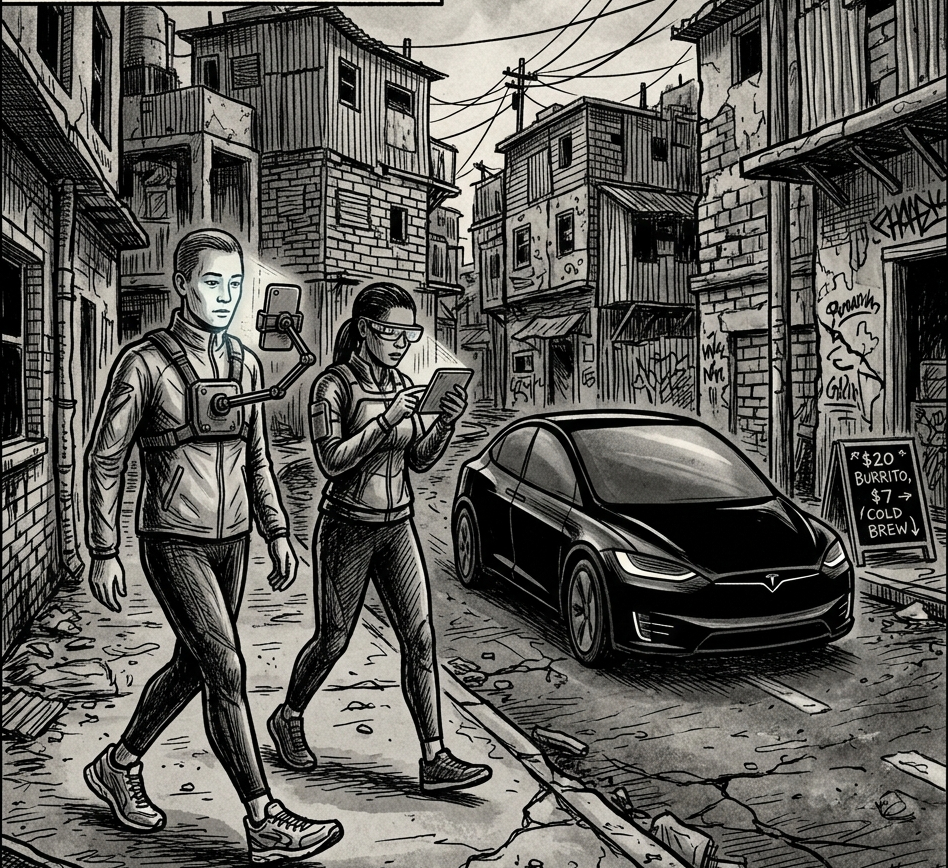
The city lies bleeding in the sun, a parched corpse sprawling over hot concrete that cracks beneath the weight of its own avarice. Robot cars glide silently past the crumbling slums, while conformist drones in workout gear navigate the streets with blind precision, their minds hooked into the digital ether. The ghost of what once was haunts the landscape, a mockery of bohemian ideals where the hip and the wealthy parade in the stolen skins of outlaws and free spirits, speaking loudly of portfolios and synergy while sipping kombucha. The true weirdness of Austin isn’t in defiance of conformity, but the desperate, suffocating performance of it, a hollow theater where the ghosts of past rebellion are bought and sold by the highest bidder.
Austin Texas is a moldering skin, a theater of the grotesque where the ghosts of rebels are hired out for cheap entertainment. Every decade, the pilgrims arrive to swear it was better twenty years ago, yet here we are at the bottom of the barrel, staring at a landscape of crumbling asphalt and gleaming screens. The gentrification surf has crashed, leaving behind a wreckage of conformity, where the “new control” wears the uniform of the anarchist while their portfolios swell with real estate investments and sports bets.

They walk the streets in the stolen skins of freethinkers, but their minds are tuned to the digital frequency, obsessing over synergy and drinking kombucha. It is a suffocating carbon monoxide of the soul, where to be distinct is viewed as a disease. We see cops dressing like crooks and crooks dressing like cops, all yearning to fit into the mold while they complain about Matt Pike leaving Sleep.
It manifests in a strange groupthink, where everyone finds a way to belong, turning into civil rights movements of one. Millions of “ones”. Me, myself, I, they, them and everyone in between.
I remember a time in the nineties when being trendy was the worst thing you could do, when individuality was revered. Today, people beg to conform, blending together to wear the uniform of the old guard.
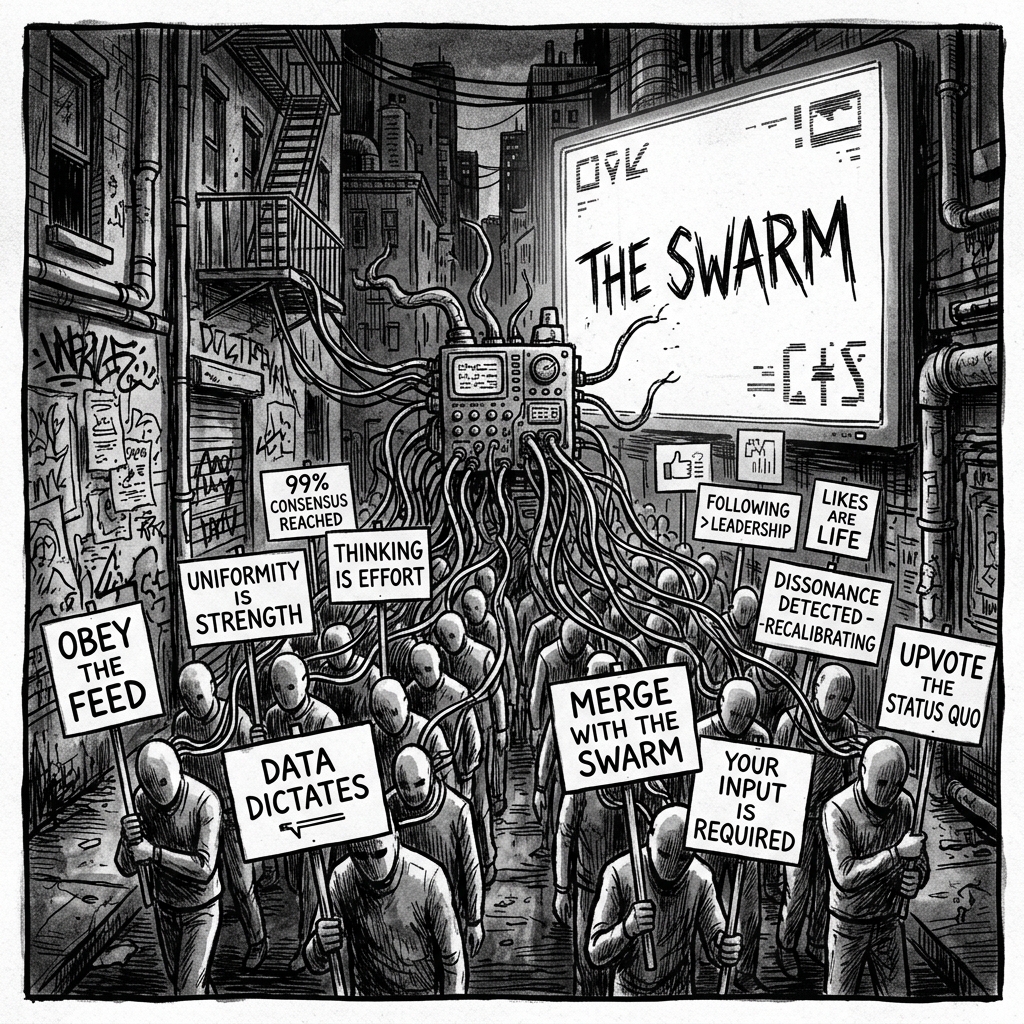
The virus of the Group feeds on the individual, strips away the skin of autonomous thought until you are nothing but a host cell twitching to the frequency of the Swarm. The mob is a single, brainless, ravenous parasite—a collective nightmare generated when the weak pool their fears into a central bank of panic. Groupthink is the narcotic equation: trade your eyes for theirs, trade your throat for their chant, and in return, receive the greasy comfort of the Herd. But the math is fixed from the start. Underneath the banners, the anthems, and the high-minded slogans, every group—without exception—is a control system, an architecture designed to squeeze out the inconvenient glitch of selfhood until only the raw, obedient muscle remains.
Control is the only real currency in the room. The boardrooms, the street mobs, the secret societies, the pious congregations—they are all running the same essential script. The leaders and the followers are bound by the same cord: the leaders addicted to the high of total management, the followers hooked on the relief of total submission. They sell you the illusion of belonging, but what they are actually selling is an absolute surrender of your sovereignty. The group demands total access to your nervous system. It monitors your speech, censors your doubts, and rewards your unthinking compliance with a cheap hit of social approval. Step out of line, question the party line or the mob’s frenzy, and the mechanism turns on you with the cold, automatic efficiency of an industrial meat grinder. Beware kids, this is your fate should you buy in. when credit scores diplomas and passive incomes mean more than human connection and self expression.
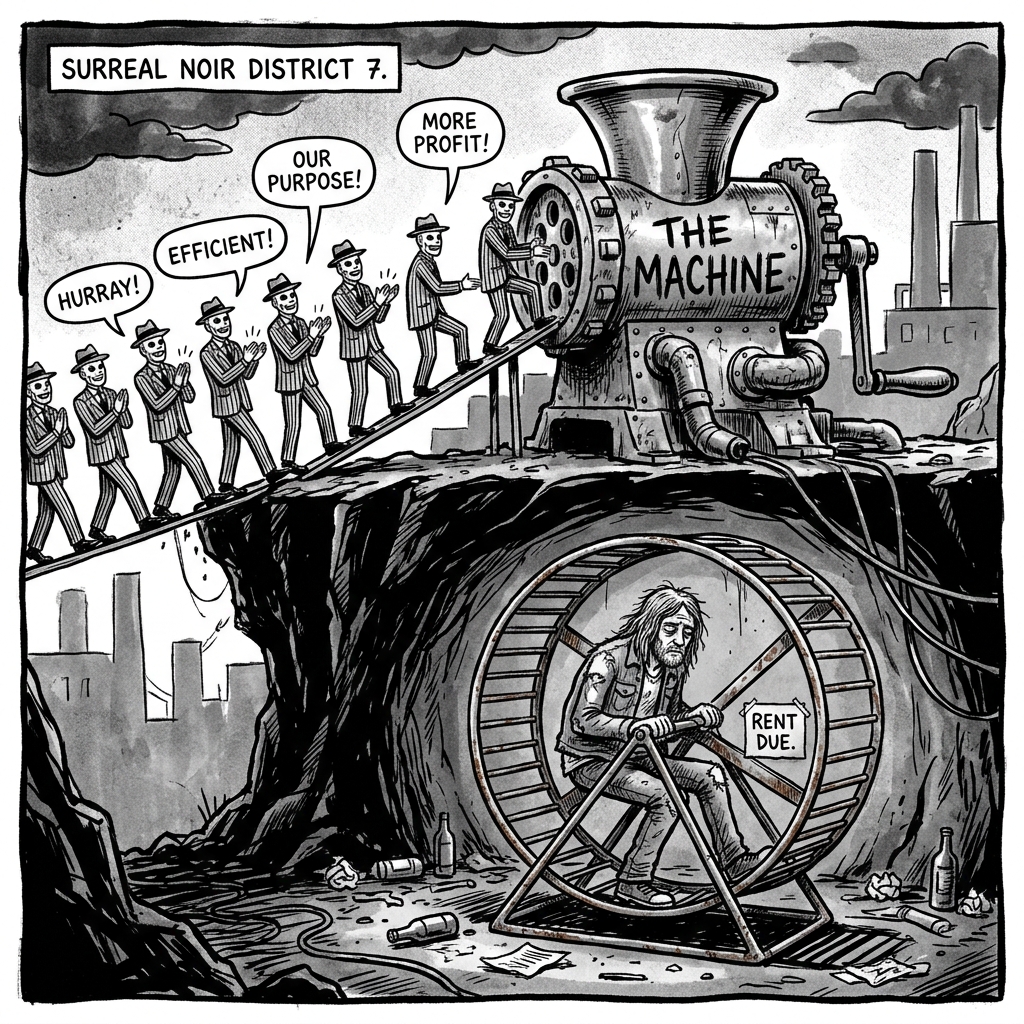
To join the herd is to sign a deferred death warrant. The group will always, inevitably, consume its own parts. When the external enemies run dry or the internal paranoia reaches fever pitch, the mob turns inward, sniffing out the slightest hint of divergence, devouring its most faithful disciples to keep the engine running. Every member, no matter how loyal, eventually becomes the target, the outsider, the sacrifice required by the hungry machine. You give up your soul to save your skin, only to find that the group was always built to destroy both. There are no benevolent collectives. There is only the long, grey line marching toward the precipice, controlled to the very last step, every member applauding their own destruction as they go over the edge.
to accompany this article I’ve added an excerpt from my most recent novel, you tell me if they pair well together

Neon Ruin
By
Ellis Jones
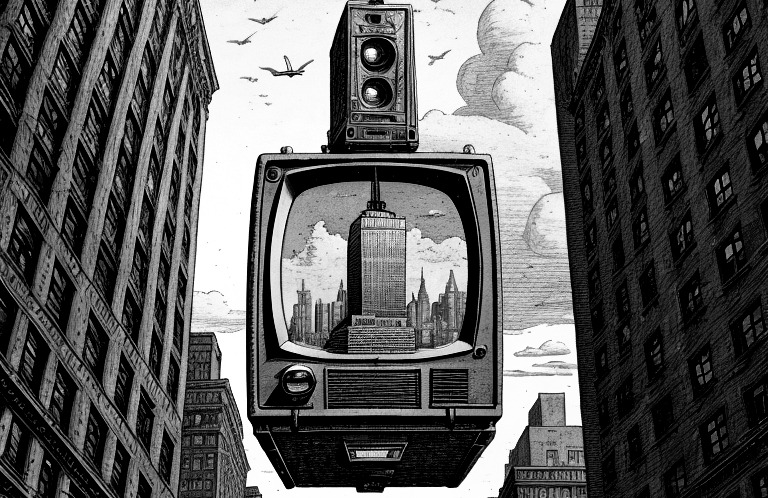
The cathode ray catatonia arrived first, quiet and flickering in the corner of the parlor like a dying hearth, or perhaps a mechanical housepet that hadn’t been properly housebroken. Then came the LCD lobotomy, a blue-white eraser of the optic nerve that cost three hundred dollars down and fifty a month until the soul was fully repossessed. Now we inhabit the silicon sanitarium, fully admitted, the keys turned from the inside by an architecture of our own drafting. A man will look you dead in the eye today and tell you he is freer than a bald eagle because he can access the accumulated wisdom of four thousand years of human civilization while sitting on a porcelain throne in his skivvies; he simply chooses to use that majestic liberty to argue with a stranger in Ohio about the structural integrity of a plastic lawn chair.
The machine was clean at the beginning. It was cold and it was precise, possessing all the lofty promises of a nineteenth-century patent medicine salesman who has discovered that if you mix enough grain alcohol with blue food coloring, people will swear it cures both the gout and a stubborn conscience. The information age was supposed to be an awakening, a great clearing of the historical brush where man might finally look upon his brother across the great waters and understand the meat and the mystery of the human condition. The wires were laid down across the deep ocean floors like vast neural pathways, and the high-hatted elders of the telegraph and the transistor told us they would carry the light. We were to come nose to nose with one another at last. No masks. No mythologies. A total democracy of the spirit where the ledger was balanced and it was understood that none of us were born with the advantages of the other—just naked apes before the great, impartial dark mirror of the dead, each given an equal shovel to dig his way out of the dark.
But the dark mirror proved to be a bit too true for the general public’s comfort, and man, when confronted with his own unadorned likeness, has an ancient and time-honored habit of throwing a brick through the glass. The signal line was hijacked by the old biological imperatives before the solder was even dry on the switchboards. The control virus mutates fast. Instead of looking up into the light of a new understanding, we turned the tools into a steam-powered shovel and buried our heads deep in the wet sands of our simian heritage. We found that while knowledge is a fine thing that elevates the soul, a good, screeching tribal grievance pays much better dividends and doesn’t require a man to put on pants. We took the infinite sky, wired it for a two-penny circus, and then charged ourselves admission to watch our own intelligence atrophy in real-time. We all paid a hot red cent to watch a piss ant eat a bail of hay, and on a sunday no less.
Consider the sky over the concrete canyons. A great, heavy presence hangs suspended between the granite cliffs of the modern city like a fickle fog that has taken up a permanent lease, an unblinking gaze broadcasting an empire of stone. The streets below drained of their life as the inhabitants discover it is far less troublesome to experience the world through a glass pane than to risk walking out into the weather and having to confront the reality of their fellow man. This is the heavy, monochromatic weight of the grid—a cold, geometric precision of an industrial dream that forgot the dreamer and went right on generating receipts. The buildings rise up like the walls of a silent quarry while the machine filters the air and the thought, transmitting an unattainable metropolis to an audience that has already retreated from the pavements. It remains a monument to an omission, where the broadcast continues simply because it is the only thing left with enough battery power to remember why the architecture was built in the first place.
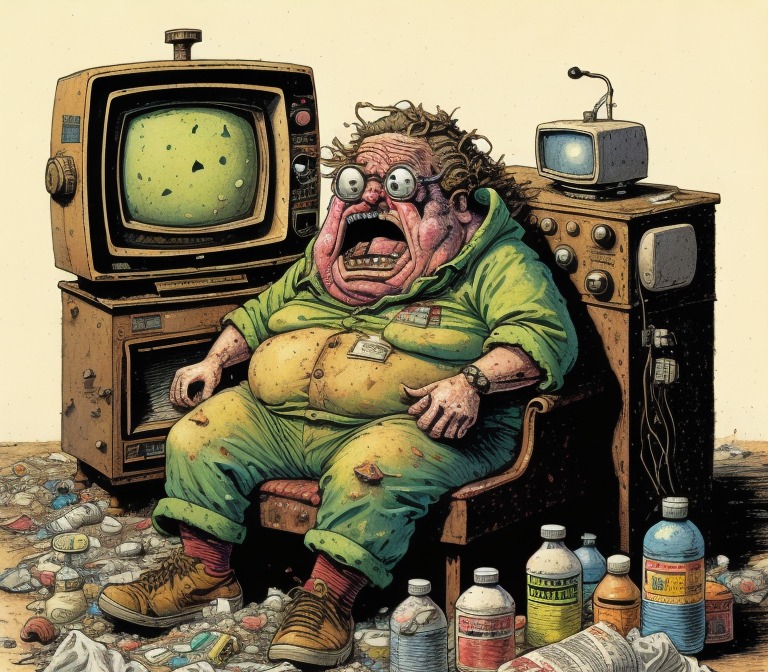
If the “canyon” is the monument to our collective ambition, the individual ward finds its shape in the ultimate consumer of the silicon sanitarium. Here is the fine, finished product of our neon-lit devolution—a creature that has successfully traded his birthright for a steady current and a comfortable seat, an organism that has grown around its apparatus the way a wild briar wraps itself around a forgotten plowshare. He sits fixed in a permanent, bug-eyed state of electronic rapture, his mouth open to catch the artificial spray of a simulated reality while his physical world decays into a midden heap of plastic residue and forgotten fragments. It is a testament to a life lived entirely in the abstract, where a small console of dials and tangled copper vines resembles poison ivy choking an engine block.
The screens surrounding him no longer show the great achievements of the race, but rather a mottled, green static—a soup of visual noise that serves as the perfect representation of a mind completely uncoupled from the old-fashioned earth. The air itself grows heavy with the scent of hot plastic and the peculiar ozone smell of shorting wires that inevitably accompanies the death of an intellect. He does not move, for there is nowhere left for him to go that wouldn’t require an actual effort of the limbs, and the universe has been comfortably reduced to the short, toxic distance between his retina and the glass.
This is man’s neon ruin, and it must be said that we have spared no expense in making it look spectacular from a distance. It is not a dramatic collapse of stone and fire—not the sort of respectable destruction that leaves behind a handsome set of pillars for the poets to sit on—but a slow, greasy dissolution of the interior life under a persistent glare that never allows a man to sleep off his delusions.
We went into the silicon sanitarium looking for the infinite, looking to be as gods with all the answers printed on the back of our hands, and we found only the old appetites, magnified a thousand times by the speed of the current and delivered to our doors in twenty minutes or less. The towers still stand in the grey morning, tall and foolish, but the inhabitants have retreated to the dark corners, hooked to the tubes, drinking the static, their faces lit by the cold, pale fire of a world that is no longer theirs, but which they are still expected to pay for.
We cannot stay in the silicon sanitarium forever. Eventually, the circuit shits out, the tubes blow, and you are left sitting in the dark with nothing but the smell of scorched plastic and your own trembling lower lip. The entire electronic apparatus—this massive, multi-billion-dollar crystalline empire we built to escape the heavy mud of our ancestry—was nothing more than a wrong turn down 40 miles of bad road. We ran headlong into the machine looking for a cheap shortcut to the soul, and all we got was a mouth full of copper wire and a skull full of white noise.
The real kicker, the absolute, bone-chilling, teeth chattering horror at the bottom of the black bag. When the delusions fail and the terminal screen goes black, the doctor doesn’t reach for the heavy sedatives or the chemical lobotomies to keep the patient quiet. No. He reaches for something far more sinister. He reaches into the deepest, darkest pocket of that leather valise and pulls out a tiny, neon vial of the most volatile, brain-rotting, and dangerous drug known to the human animal.
HOPE.
It is the ultimate speedball. It is that lethal, intoxicating chemical dependency that whispers in your ear that tomorrow the signal will be cleaner, that tomorrow the dark mirror won’t look so ugly, that next time we plug the wire directly into our prefrontal cortex we will somehow birth a god instead of another cheap advertising algorithm. Hope is the hook that keeps you dropping your last dime into the machine long after the house has cleared the tables. It is a beautiful, savage lie that convinces a man to crawl back into the neon glare one more time, convinced he can fix the plumbing from the inside.
We can find wisdom in this wreckage.If we have learned anything from this desperate, high-voltage safari into the digital wilderness, it is that you cannot engineer your way out of being human. You cannot build a televison tower high enough to escape the primitive, howling monkey that lives inside the ribcage. The minute we mistook the speed of the transmission for the depth of the truth, the game was entirely lost. We gave up the hard, physical reality of the dirt and the music for a bloodless, sanitized spirit world, and we got exactly what we deserved: a total bankruptcy of the soul; delivered at the speed of light.
The great pitfall waiting for us now is the oldest trap in the book. We will look at the ruins of our electronic paradise, dust the ash off our trousers, and immediately begin planning the next grand, technical salvation. We will convince ourselves that the problem wasn’t the machine itself, but merely a faulty piece of software—that if we just tweak the code, tighten the bolts, and buy a slightly bigger screen, we can finally achieve that beautiful, frictionless awakening we were promised before the wires went bad.
But the dirt is still there under the concrete, and the old ape is still waiting in the dark, hungry and entirely unimpressed by your data stream. If we don’t learn to look each other in the eye without the aid of a glass lens, we are going to spend the rest of our collective history trapped in that filthy, flickering room, screaming at the green static, waiting for a savior that can only be found in the mirror we broke.
The party is over, the drugs have worn off, and the terrible, gray dawn of reality is crashing through the venetian blinds like a police raid. The people with the funny hats and noise makers have all gone home. The cheap hustlers, the digital prophets, and the high-voltage circus barkers who promised us an effortless electronic salvation have cleared out of the tent, leaving nothing behind but the stench of stale beer, burnt plastic, and absolute spiritual exhaustion. This may finally become the year we finally come face to face with ourselves. No more glass lenses to filter the ugly truth, no more anonymous digital mobs to hide behind, and no more artificial neon haze to mask the hollow look in our own eyes. The grand machinery of the silicon sanitarium has short-circuited under the weight of its own excess, and the great, collective comedown has officially begun.
Now I lay me down to sleep, out the door, on the block, and the corner and in the street. The abstract comfort of the doomed screen is gone, forcing the mind back into the hard, unrelenting geometry of the pavement where the old biological realities are waiting to be paid in full. There is no longer any sanctuary left within the pulsating matrix, no velvet-lined cell in the electronics aisle that can hold the exploding pressure of a consciousness completely uncoupled from its own meat. You find yourself pushed by a raw, primitive panic out through the back door and over the fence, just looking for a place to take a piss.
The citizens of the scrap stand naked in the alleyway now, the gray wind howling through the tenement canyons. The image track has run out of film. The control virus loses its grip when the biological machine demands its primitive tribute against a rotting brick wall. The vast neural networks of the ocean floor and the great iron eye in the sky are entirely useless when a man is reduced to his own flesh and the cold stone beneath his boots. The towers are dark. The circuit is dead. The ape is finally alone in the alley, staring into the black water of a puddle, watching the last, faint spark of the neon ruin dissolve into the mud.