The Cuyahoga Conundrum
By
J.L. Heggum
Listen: Cleveland, Ohio, is a place that happened because geography has a wicked sense of humor. History, which is mostly just a series of bad surprises mapped out on yellowed parchment, deposited a city at the mouth of the Cuyahoga River back in 1796. A surveyor named Moses Cleaveland looked at a mosquito-infested death trap on the southern shore of Lake Erie and declared, “This looks like a splendid spot to build an empire of heavy industry and existential melancholy.”
They built it. They forged steel, they pumped Standard Oil, and they manufactured dreams out of coal dust and lake-effect snow until the river literally caught fire in 1969 because the water was ninety percent industrial runoff and forty percent pure regret. It is a town built on grit, ambition, and the stubborn, Midwestern belief that frozen slush is a character-building exercise.
As a man hailing from the sun-bleached, fog-choked edges of the San Francisco Bay—where the Pacific Ocean tosses up wild salmon and Dungeness crab like casual afternoon greetings—my understanding of aquatic sustenance is coastal, proud, and deeply snobbish. But travel teaches you that when you step outside the church of the tide, the world gets weird.
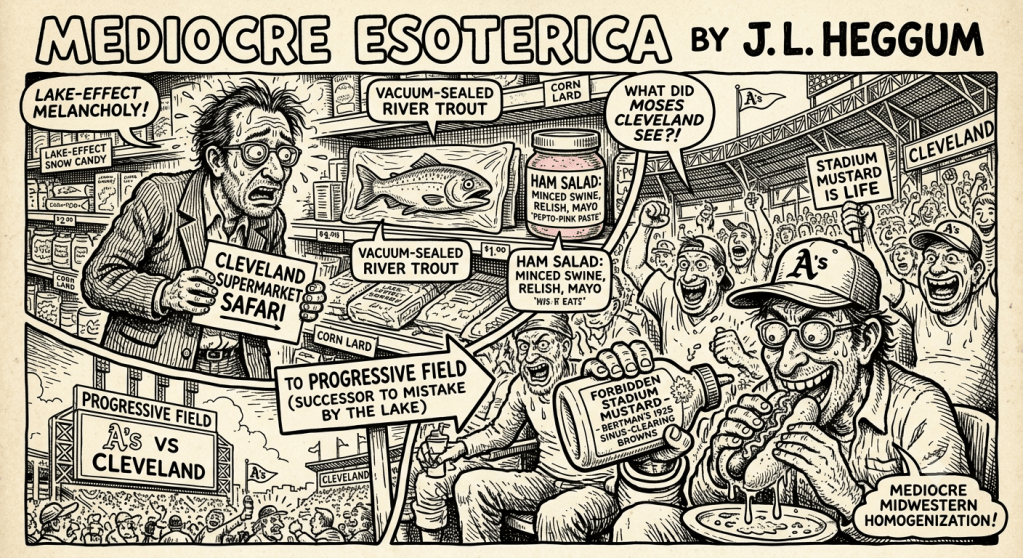
Consider my afternoon excursion into a neighborhood grocery store aisle, lit by the unforgiving hum of fluorescent tubes that sounded like a dying hornet. There, staring back at me from a refrigerated shelf, was packaged river trout. Not swimming, not leaping upstream, but vacuum-sealed in plastic like an unlucky passport photo, floating in its own despondent juices. It was a haunting, lifeless monument to freshwater isolation.
And then, nestled right beside the industrial luncheon meats, I encountered the holy grail of Midwestern culinary surrender: Ham Salad.
Now, I am a man of the world. I have known chicken salad, and I have nodded politely at egg salad. But ham salad? This was something entirely different—a pale, pepto-pink paste composed of finely minced swine, heavy lashings of mayonnaise, and sweet relish, ground down to a uniform, socialist mush. It didn’t look like food; it looked like a geological core sample from a municipal landfill.
Standing there in the aisle, looking at that tub of pink sludge, I realized ham salad is the ultimate metaphor for the mediocre esoterica that is Midwestern life. Everything is chopped up, homogenized, bound together by a thick, gluey layer of social conformity, and spread thinly across white bread. There are no sharp edges here, no bitter bones, no untamed ocean currents—just a comfortable, predictable mediocrity that tastes faintly of sweet relish and total resignation.
Pondering this profound philosophy of processed pork, I decided the only proper antidote was a pilgrimage to the local ballpark—Progressive Field, the spiritual successor to the crumbling concrete monolith of Municipal Stadium, famously known as the “Mistake by the Lake.” im starting to think this would have been a more appropriate name for the entire city and surrounding areas.
The matchup on the diamond was Cleveland against my beloved Oakland A’s. This is a rivalry older than automobile insurance, stretching all the way back to 1901 when the American League was first born as a scrappy upstart circuit. Back then, Connie Mack’s original Philadelphia Athletics were trading blows with the Cleveland Naps, (ha! How appropriate the team was named for the best use of your time in cleveland…napping.) shifting geographies across Kansas City and Oakland over the decades like nomadic tribes of flannel and wool. They have played thousands of games against each other, a long, weary loop of baseball geometry played out across the American continent, where the uniforms change but the heartbreak remains identical.
To survive a game between these two vintage franchises, a spectator requires fuel. And in Cleveland, that fuel is Stadium Mustard.
For generations, this dark, ferocious, sinus-clearing brown mustard—originally concocted by Joe Bertman back in 1925—was an outlaw condiment. For years, you couldn’t buy it in regular grocery stores; it was sold exclusively inside the stadium gates, a clandestine substance traded like bootleg whiskey behind home plate. It bites back with a vengeance, a sharp, vinegary slap to the cerebral cortex that makes you forget, if only for nine innings, about packaged river trout and pink ham salad.
As the A’s grounded into a double play in the seventh inning, I sat in the Cleveland night air, eating a frankfurter dripping with forbidden mustard. And I figured: life is short, the Midwest is strange, and sometimes a jar of pink paste is just a jar of pink paste.
***
J.L. Heggum
“a collection of random facts to expand your mind.”
the shortest war in history lasted only 38 minutes. It was fought between Britain and Zanzibar on August 27th, 1896.
The first vending machine was invented in ancient Greece and dispensed holy water.
a group of flamingos is charmingly known as a “flamboyance,”
bananas are curved because they grow towards the sun against gravity in a process called “negative geotropism.“
Nintendo was founded way back in 1889 as a playing card company,
Bram Stoker’s Dracula was originally titled “The Un-Dead.”
Cleopatra lived closer in time to the construction of the iPhone than to the building of the Great Pyramid of Giza
“strengths” is the longest English word with only one vowel.
a “jiffy” is an actual unit of time, specifically one one-hundredth of a second.
all the Beatles‘ haircuts were originally styled by George Harrison’s wife in Liverpool.
honey found in ancient Egyptian tombs, has been found to be still edible
the moon experiences moonquakes, very similar to earthquakes but caused by the gravitational pull of the Earth.
a shrimp’s heart is located in its head,
wombats are the only known animals to produce cube-shaped poop.
the search engine Google was originally called Backrub
sloths can hold their breath underwater for up to 40 minutes, which is actually longer than dolphins.
the Eiffel Tower can be up to 15 centimeters taller during the summer due to thermal expansion.the sentence “Buffalo buffalo Buffalo buffalo buffalo buffalo Buffalo buffalo.” is grammatically correct.

