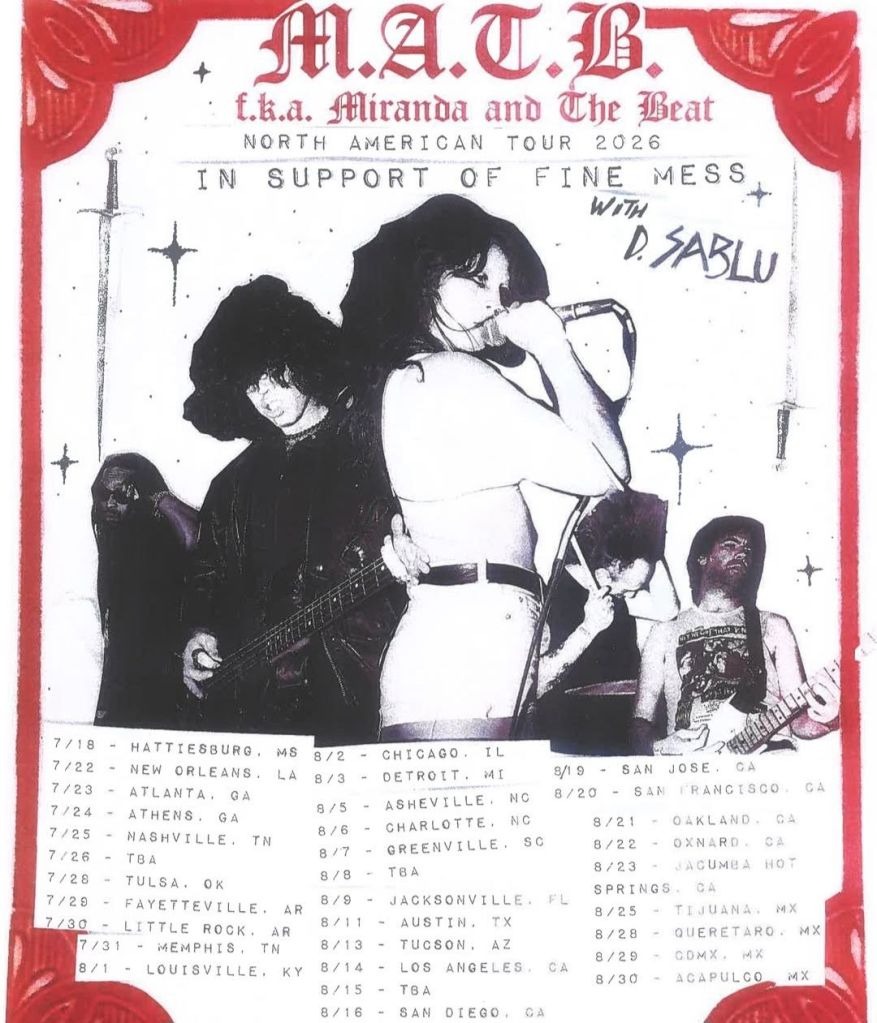
It was the season of resurrection in a city drowning in decadence and sin—Gay Easter in New Orleans, 2026. Amidst the glitter and the grotesque, I stumbled upon the unholy alliance of Dustin Dollin, and the electrifying force of Miranda and the Beat.
We converged at Bud Rips bar, where they were spinning tales of King Khan, the mad maestro of the underground, painting a portrait of creative insanity that bordered on the divine, all while plotting a crusade of sonic mayhem. This is not merely a tour; it is a collision of worlds, a celebration of the raw, unfiltered spirit that refuses to die. Fine Mess, born from Dollin’s broken knees and insatiable desire for volume and excess, collided with Miranda and the Beat’s infectious energy. They stand as the torchbearers of a sound that exists outside of time, ready to dismantle the monotony of the mainstream.
At the heart of this crusade is Miranda and the Beat, a cyclone of sound that blends garage rock fury with a relentless rhythmic drive. Driven by infectious melodies and a theatrical stage presence, they transform every venue into a sweat-soaked sanctuary of rebellion. They are an unstoppable force of nature that leaves audiences simultaneously exhilarated and terrified—a testament to the enduring power of unadulterated rock and roll ejaculation, it is a ritualistic awakening, a reminder that some spirits cannot be tamed.
***
The year was 1784, a time when the great, gray engines of Empire ground up the lives of men like so much grain between millstones, and the dark, salted waters of the global deep were thronged with vessels bearing the spoils of conquest. Upon the cold docks of London, where the fog hung thick as tallow and smelled of Thames mud and horse dung, was loaded a cargo ship of singular and curious potency. It had been discovered by the calculating merchants of the East India Company that the delicate, pale ales of the mother country, when subjected to the sweltering heat of the tropics and the agonizing, five-month tossing of a wooden hull round the stormy Cape of Good Hope, arrived in the East Indies as sour, putrid slop fit only for swine. To remedy this ruinous loss of profit, a cunning brewer had devised a stout, uncompromising concoction—stuffed to the very bung with an obscene abundance of fragrant, bitter hops, those green resinous pinecones of the soil which acted as a natural preservative, and brewed to a monstrously high strength of spirit. It was a beer forged for war and heavy weather, designed to age and mellow under the relentless beating of equatorial suns, so that the dry, parched throats of the King’s red-coated mercenaries in Calcutta might be slaked with a taste of home.
To transport three hundred heavy cases of this precious, bitter elixir through waters crawling with French pirates and sea-lawyers, the Company engaged the services of the Alabaster Butterfly. She was a vessel of peculiar and striking aspect, her stout oak timbers painted a blinding, chalky white that gleamed like a bleached whale-bone upon the dark Atlantic, while her canvas sails was dyed a rich, regal blue that flapped against the heavens like the wings of some celestial moth. She was commanded by Captain Miranda “Big Randy” Zipse, a woman of formidable, mountain-like breadth and iron resolve, born in the reeking shadows of a London tallow-chandler’s shop, who had traded the sniffing of rendered beef fat for the wild, salt spray of the main. Beside her stood her first mate, Dylan “Baby” Fernandez, a man whose smooth, unwrinkled face belied a dark and violent past as a Spanish conquistador in the fever-ridden jungles of the New World’s “La Florida” (land of flowers) insearch of ponce de leon’s fountain of youth, before he cast his lot with the freebooters. The guiding intelligence of this floating parish was Alvin ”M.F.” Jackson, a brilliant African navigator who had escaped the clutches of a dozen slave-captains and could read the whirling constellations of the southern hemisphere as easily as a scholar reads a Bible. Keeping the rhythmic pulse of the vessel was Christian “Sugar” King, a petty thief from the gutters of Whitechapel whose sole duty in this life was to stand upon the maindeck and pound relentlessly upon a massive leather work-drum, driving the men to their ropes with a cadence like a heartbeat.
The rest of this wretched, motley ship’s company was no less strange. There was Dustin Dollin, a filthy, foul-mouthed Australian cabin boy who possessed an unquenchable, wolf-like thirst for alcohol and an utter disdain for all moral law; and Arish Khan, an ousted Indian monarch of deposed grandeur, disgraced and cast out from his jewel-encrusted court, now reduced to serving as the ship’s cook, though the crew mockingly insisted on calling him “King Khan.” To soothe the tormented souls of these sea-dogs sang the lovely Miss Julia, a troubadour of tragic beauty whose voice could bring a hardened cutthroat to tears; while the ship’s dark, thunderous firepower was entrusted to D. Sablu, a silent, mysterious figure who moved among the heavy iron cannons like a shade from the underworld, his skin forever smudged with black gun-powder.
For weeks, the Alabaster Butterfly ploughed through the desolate waste of the sea, the blue sails straining against the trade winds as the white hull sliced through the iron-gray swells. But as the ship neared the blistering, windless latitudes approaching the Indian Ocean, a dreadful silence fell over the mess-deck, broken only by the eerie, rhythmic thump-thump-thump of Sugar King’s drum. The crew began to notice their bellies gnawing at their spines, for the mess tables were barren. Upon investigation into the dark depths of the hold, a horror of cosmic proportions was laid bare. King Khan, driven mad by the insatiable, gluttonous hunger of his lost royalty, had systematically devoured every salt-pork ration, every hardtack biscuit, every dried pea, and every barrel of salt beef stored within the ship’s dry lockers. Yet a far worse sacrilege had been committed by the wretched cabin boy, Dustin Dollin. The Australian beast, driven by the howling, demonic DTs of a chronic drunkard, had breached the sacred beer-room. Day after agonizing day, he had guzzled the high-gravity India pale ale, guzzling barrel after barrel of the precious, hoppy nectar, and in a twisted effort to conceal his crime from the sharp eye of Captain Zipse, had filled every single empty cask and bottle to the brim with his own acrid, pale urine.
When Captain “Big Randy” Zipse stood in the gloom of the hold, staring at the empty meat-crates and smelling the undeniable, sharp stench of stale piss wafting from the high-value cargo, her face turned the color of a bruised plum. The realization struck the crew like an iron cannonball: to arrive in British India with three hundred casks of royal urine and a belly full of stolen beef was to invite a swift judgment from the Royal Navy. They would be chased to the ends of the earth, ironed, court-martialed, and left to dance the hempen jig from the yardarms of the King’s warships. The mission was dead. The Empire was cheated.
Justice on the high seas was swift, merciless, and primal. Before the setting sun could dip below the blood-red horizon, a long, pine plank was run out over the starboard rail of the Alabaster Butterfly. King Khan, weeping for his lost kingdom and his bloated, over-stuffed stomach, was marched out at the point of Dylan Fernandez’s sharp cutlass, until he stepped off into the deep, dark abyss of the warm ocean, left to the cold mercy of the sharks and the silent depths. As for the pissy drunkard Dustin, he was lashed to the mainmast to be beaten sober by the spray of the sea.
With the Royal Navy sure to be hunting their blue sails across the eastern seas, Captain Zipse spun the ship’s wheel with all her formidable weight. Alvin ”M.F.” Jackson laid out his brass dividers across the stained sea-charts, shooting the stars with his sextant and laying down a new course away from the claws of the Crown. They turned their bow westward, away from India, setting their sights across the vast expanse of the Atlantic toward the muddy, cypress-choked delta of the Mississippi River. They were heading for the port of New Orleans—a wild, lawless, swamp-surrounded haven where Spanish, French, and pirate blood mixed freely in the taverns, a land that asked no questions of a white ship with royal blue sails, and where a crew of broken, rogue souls could lose themselves forever in the dark, sweet fog of the southern bayous.
***
Austin, Texas. United States of America. 4:30am August 1st, 2026… klik…klik and a half from lady bird lake.
I sat up in the dark, my chest heaving, my shirt soaked through with cold sweat. I check the Chainsaw email to find a press release from MIranda. And one simple sentence: hold on to your nuts millhouse we are gonna be in austin in a week and a half and you are going to cover our show at the 13th Floor. I read the press release while drinking a warm beer off the night stand.
“Randy talks about the new single “Make It On My Own,” “This song was written about shedding things and people that no longer serve you. It is yours now, take it and make it what you want.”
M.A.T.B. (f.k.a. Miranda and The Beat) don’t ask for your attention, they steal it. Born out of the NYC gutters and now wreaking havoc from the vulgar depths of New Orleans, the band has been tearing shit up since 2018. Raw, reckless, and riding on a no-rules gang mentality, M.A.T.B. hits hard and leaves you begging to get hit again.
Miranda “Randy” Zipse wasn’t born into this world. She exploded from it, a human hurricane armed with a Telecaster and a scream that could tear down walls. For almost a decade, she and Dylan “Baby” Fernandez (Farfisa, guitar) have thrived in chaos concocting melodies, riffs, and hooks that bite as hard as their live shows hit. Backed by their fearless comrades Alvin ”M.F.” Jackson on bass and Christian “Sugar” King on drums, this crew refuses to fade. The band that just won’t go away is ready to infest your brain like the cockroaches they are.
M.A.T.B. has relentlessly torn through the U.S. and Europe on many a ferocious tour cycle, leaving sweat, noise, and mayhem in every city. On stage they’ve run with the depraved and legendary: The Black Lips, The Spits, The King Khan & BBQ Show, Bad Nerves, The Gories, The Mystery Lights, and more. Along the way, they’ve released music on Third Man Records, Khannibalism/Ernest Jenning Record Co., and Wild Honey, with some of the production/mix damage overseen by Nick Zinner (Yeah Yeah Yeahs) and the sonic wizard Paul Millar.
On their new LP Nerve Damage, soon to hit shelves, M.A.T.B. blends their scorched punk n roll energy with 80s new wave menace, creating a sound that punches like the Ramones, chills like John Carpenter, and sneaks in the cold precision of neue deutsche welle and OG hardcore influences. Tweakin out while digging through some trash? Spin “SPATZ.” Late night, full speed, never coming back? That’s “Make It On My Own”. The chaos does not stop. Nerve Damage grabs you, punches, screams, and refuses to let go.
Hell, don’t take my word for it. I honestly haven’t even heard the album yet (not sure it exists, and if it does it probably sucks) but here’s what Randy herself has to say about it, “Nerve Damage is about embracing the dark and disgusting parts of yourself because the more beat up we become by life, the more beautiful and unique we become. M.A.T.B. is comin at ya and it’s only gonna get better.” “
***
There is a manic desperation lurking in the underbelly of American rock and roll, the kind of madness that compels human beings to cram themselves into a crushed, un-airconditioned metal box and hurtle down the asphalt arteries of this continent..The band is M.A.T.B.—formerly Miranda & The Beat—a blistering sonic machine fueled by cheap beer, total exhaustion, and the ghostly lineage of every powerful woman who ever spat fire into a microphone, from Chrissie Hynde and Debbie Harry to Courtney Love, minus the terminal self-destruction.
The tour kicked off in New Orleans, bleeding through a nonsensical, zigzagging logistical nightmare across the South and the Midwest—Jacksonville, Charlotte, Detroit, Chicago, Fayetteville—before setting its sights on the chaos of Mexico. Three bands crammed into one touring unit, with musicians trading instruments and taking the stage for two to three brutally punishing sets a night, all to avoid the ego-poison of tracking who’s doing the most work, though the truth points to the one known only as “El Jefe”, a man serving as driver, accountant, band therapist, and designated peacekeeper, until his breaking point. Legend has it that after a frustrating stretch on the road, Jefe freaked out and bit Alvin, took a shit in the van and pissed all over Dustin’s beers.
The road, of course, demands its blood tax. One band member went missing in Central Florida after a night at a Daytona strip club, only to surface at 3:00 AM, drugged by a stripper, completely oblivious to his own trajectory until he plowed his car into a ditch, coming to rest in a canal with a live, sparking power line and an uprooted streetlight crushed onto his roof—yet miraculously managing to crawl back into the wreckage to retrieve his freshly rolled blunt before the police arrived.
When the original rental company reneged on their van contract at the starting line, they salvaged a derelict beast from Magic Carpet Vans—a tall, sprinter-style rig that had previously been wedge-pinned and crushed beneath an overpass, its roof caved in, its battery dead, and its tires deflated just to haul it out from under the overpass. Following a grueling overnight drive from New orleans to Austin, Miranda took on the ultimate bureaucratic purgatory: spending seven and a half endless hours navigating three tax offices, two DMVs, and endless red tape to secure plates and the absolute cheapest liability insurance legally possible. It is a grueling, unglamorous existence of jump-starting dead batteries, dancing on bar tops in tiny Charlotte dives, avoiding bad-news karate fights with King Khan, and dodging raccoons in the venues back stage.—a relentless, chaotic crusade where logistical agony is embraced as gospel, because on the highway of American garage rock, everything happens for a reason, provided you don’t take no for an answer.
The show at 13th Floor, was amazing of course. To me the real spectacle was the “musical chairs” of sorts where members of M.A.T.B. Fine Mess and D. Sablu took turns switching instruments. But make no mistake about it the real star of the show was Miranda. Her stage moves, singing and guitar playing shine nearly as bright as the ball of gas this tiny rock we call a planet revolves around.
There is a precise, glorious instant when the sonic payload of Miranda and the Beat hits your ear canal, and it feels like getting shoved headfirst into a broken jukebox that’s bleeding pure fuzz and echoes. What Miranda Zipse and her feral crew of road-warriors are peddling isn’t some polite, sanitized indie-rock museum piece designed for algorithm-sniffing playlist curators; it is a violent, sweat-drenched collision of garage rock, grinding 60s R&B, and screaming Farfisa-organ carnage recorded straight to tape like their lives depended on it. Dylan’s guitar doesn’t just play riffs—it snaps like a bullwhip, slicing through the rhythm section while Miranda’s vocals wail with the guttural, heart-wrenching authority of a woman who just set her own house on fire and decided to dance in the embers. It’s an intoxicating, lawless racket that captures the unwashed spirit of rock ‘n’ roll before the suits got their sterile rubber gloves all over it, serving as a desperate, louder-than-hell reminder that real music is supposed to smell like cheap beer, burning vacuum tubes, and stale exhaust fumes.
To chart their lineage is to trace a jagged line straight through the wildest corners of the noise spectrum. You hear the swaggering garage-fuzz of The Stooges and the MC5, but injected with the soulful, hip-shaking trash-rock DNA of Mick Collins’ Dirtbombs and the Detroit Cobras—all distilled through the theatrical, spy-fi sci-fi drama of Link Wray’s flick-knife guitar instrumentals. Yet, when you stack them up against the contemporary pantheon, they effortlessly bypass the self-conscious posturing of the Brooklyn garage-revival scene, carving out a space right alongside the wild, party-punk anarchy of the Black Lips, the soul-scorched garage catharsis of King Khan, and the ferocious, no-nonsense grit of The Bobby Lees or Shannon & the Clams. Miranda and the Beat don’t bother attempting to reinvent the wheel; they just slap a set of oversized, bald drag-racing slicks on the chassis, flood the carburetor with pure grain alcohol, and drive the damn thing straight through the wall at a hundred miles an hour.
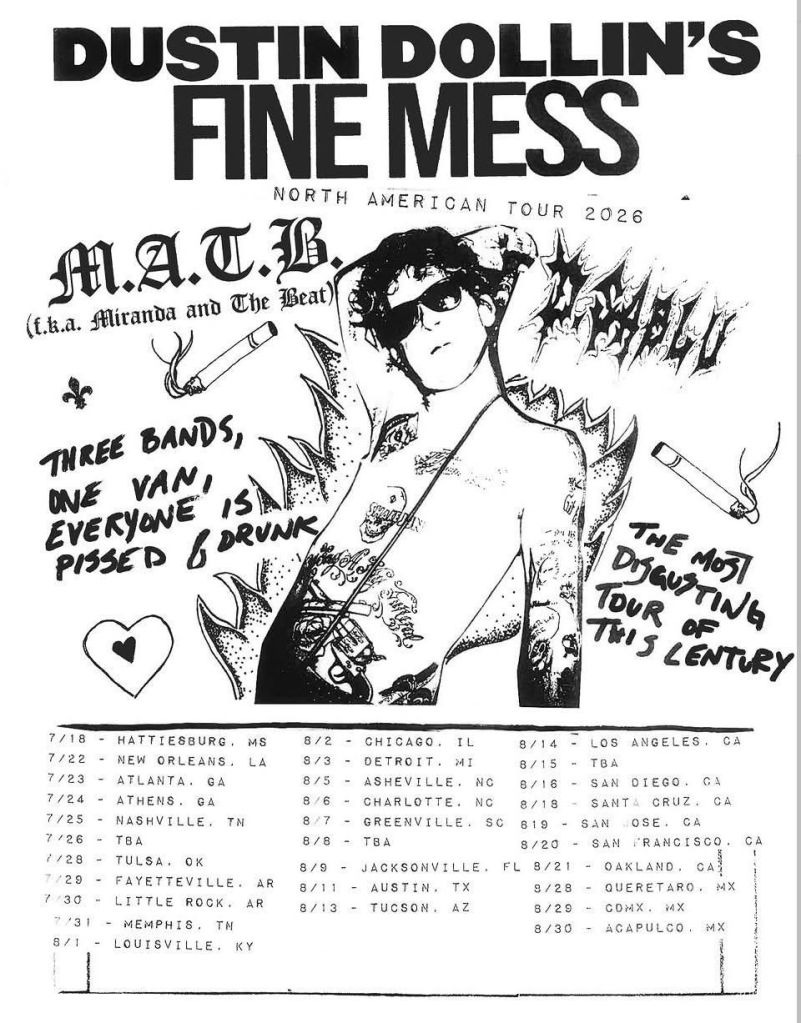
Out in the sun-bleached expanse of the African veldt, the apex predator does not waste its time looking for clean drinking water; the lion stalks its prey, tears into the warm flesh, and draws its hydration directly from the steaming, iron-flavored blood of the kill, sustaining life on pure, predatory fluid. In much the same way, as the touring circus hurtled down the endless, sun-scorched ribbons that are American highways, Dustin Dollin abandoned all conventional human metabolism, forsaking solid food and tap water entirely for long, hallucinatory stretches of the road. His body became a biological anomaly, fueled solely by a steady, relentless intake of cold Modelo—drawing every vital calorie, every drop of moisture, and every spark of maniacal energy from the golden Mexican lager like a feral beast draining a fresh carcass in the high grass.
Fine Mess is the brain child of Dustin Dollin, the battered prince of Baker Skateboards whose knees are monuments to three decades of shredding. It is the gospel of the broken and the beautiful, a symphony of distortion echoing across a landscape of despair. Dustin Dollin, the shattered deity of Baker Skateboards, drags his battered frame towards the stage, his knees a testament to a life lived on the edge. In New Orleans, on gay easter, i asked Dustin if he was still skating. He humbly shook his head no. And then offered me chocolate which I refused. He has traded his deck for a microphone, birthing a squall of noise.
There is a specific brand of unholy, alcohol-soaked madness that occurs when a professional skateboarder decides he hasn’t broken enough bones on the pavement and chooses to hurl himself into the meat-grinder of rock ‘n’ roll. Enter Fine Mess—the garage-punk assault vehicle fronted by the notorious “Piss Drunx” icon, a man whose entire existence is a high-speed, middle-finger collision with sobriety and structural integrity. Born from the grease and road-dust of Dollin’s lifelong tour-van delirium, the project carries his reckless, pavement-scraping energy straight into raw, uncomplicated punk.
The band’s genesis was less of an organized effort and more of a chaotic contagion. Partnering with post-punk label Insecurity Hits. They slapped out singles like “All I Do” and “New York”—sonic brickbats designed to sound like a basement show collapsing into its own foundation.
True to Dollin’s transient road-dog ethos, the lineup is an evolving, lawless collective of skaters, artists, and touring mercenaries. Dollin stands at the eye of the hurricane on vocals, backed by the ripping, heavy guitar hooks of Julia Pierce (ex-Cherri Bomb), messye jesse on the rumbler, the thumping drum battery of John Deluxe and Elexa Tanner, and a rotating cast of low-end co-conspirators including pro surfing lunatic Ozzy Wrong.
Musically, Fine Mess bypasses ultra-fast technical precision in favor of simple, primitive, and deeply unvarnished sounds. It is the precise point where The Stooges meet Black Lips—a dangerous mixture of raw fuzz, thumping rhythms, and loose-cannon vocal slurring, injected with the messy, party-punk spirit of King Khan’s inner circle. Beneath the blown-out distortion and threat of imminent violence, there lies the surprisingly addictive, sing-along chorus work of “Sorry Ma, Forgot to Take Out the Trash”-era Replacements, all wrapped in the old-school, reckless skate-punk heritage of JFA. It is music meant to be played loud, fast, and completely out of control, right before the engine catches fire.

