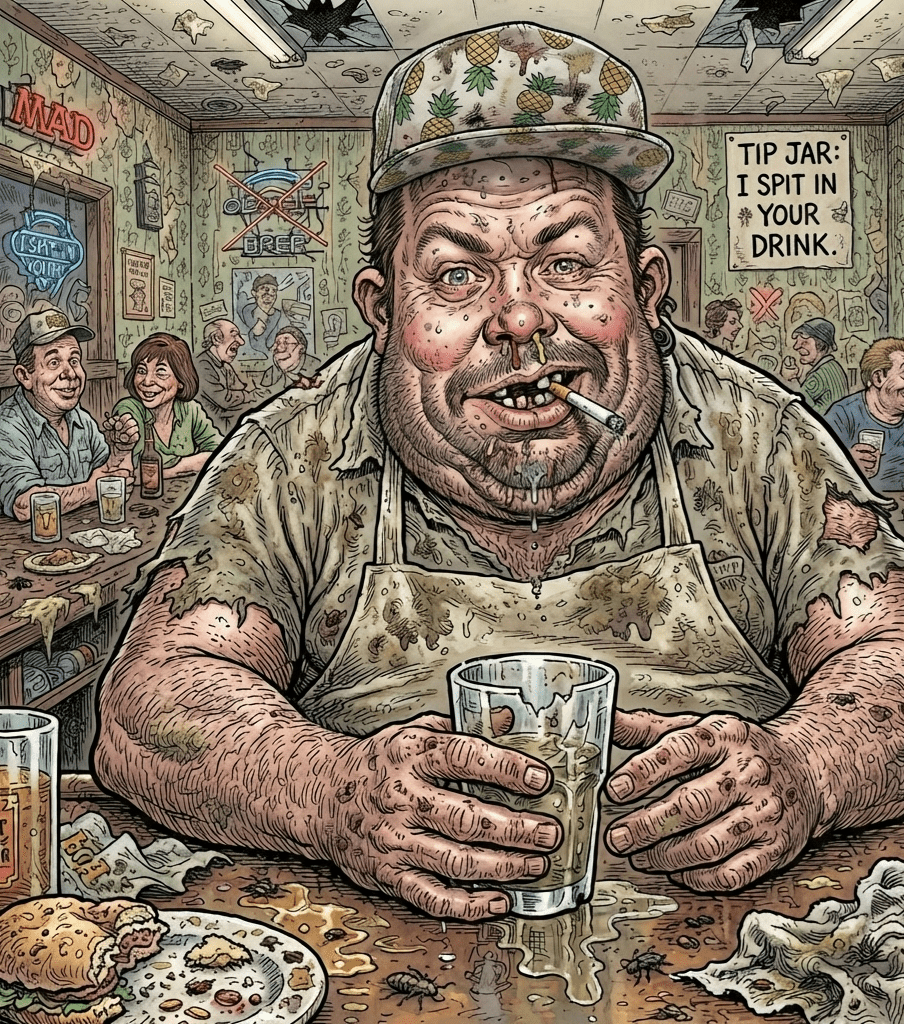
Bad Service on the Rocks: The Bartender Problem Nobody Talks About
By: Relli Calhoun
Austin, Texas, is full of bars for all walks of life. You’ve got your gay bars, dive bars, dog-friendly bars, and every other kind of bar you can think of. Just as there are multiple types of bars, there are also multiple types of attitudes that, quite frankly, I don’t have the time to put up with after dealing with eight hours of bullshit from all kinds of people—from sassy Karens all the way to self-entitled sorority girls spending Daddy’s money.
Then you have your frat guys who come in with a tab of about $2,500 and act absolutely bonkers while on the premises. But no matter the crowd, that doesn’t give certain bartenders the right to treat other customers like shit. I mean, it’s not my fault you’re working at a dead-end job, having to deal with drunks, regulars, Gen Z, and the occasional drifter who comes in just to wallow in self-pity.
All too often, and more than anywhere else, I’ve experienced—and heard—a plethora of stories about sassy bartenders. Coming from someone who has worked in the service industry for over 15 years, I can honestly say that it even extends to fellow employees. If I could count all the times I’ve gotten sass from a bartender, I’d need about two extra pairs of hands.
Honestly, I don’t understand why people come to work if they fucking hate their lives—especially if you’re a bartender. We’ve all got things going on in our lives, but it’s not my fault your landlord raised the rent, or your boyfriend or girlfriend left you for some 300-pound chick or dude in Omaha, Nebraska. I know it’s hard to leave your problems at home and not bring them into the workplace, but it seems like a lot of these bartenders live by a completely different code.
Working at a bar is stressful, especially if you can’t handle the pressure of work while balancing your personal life. For God’s sake, sometimes we just want to walk into a bar, order an Old Fashioned, and maybe watch some sports—or whatever bullshit they happen to have playing on those overhead TVs.
So what is it that makes these bartenders so ornery? Sure, we’ve all got things going on in life, but from what I understand, working at a busy bar actually pays pretty damn well. So I don’t know if they’re angry about all the money they’re making or what, but something’s got to change.
I mean, seriously.
There was a time I went into a bar where I used to work, hoping to get an employee discount on drinks for me and my friends. A certain bartender—I won’t say names. We’ll just call him “Buzz” because he favors Macaulay Culkin’s older brother from Home Alone. Anyway, I tried to order our drinks, and there was this huge altercation that could have been avoided if he hadn’t immediately gone into defense mode.
There was this senseless argument about whose card was paying the tab. Apparently, I could only get the discount if I used my own card, and the discount only applied to me and one other friend. Mind you, I never really got along with this bartender, but every time we talked, he acted like he had a twirling stick shoved up his ass. Things got heated, and I ended up getting a strike against me. I guess it was a seniority thing.
And I say all that to say this:
We, the people of America, don’t want any issues. Well… most of us don’t. And we certainly don’t want shitty bartenders on the rocks.
I’m not pointing any fingers—you all know who you are.
All I’m saying is let’s try to be one big, happy community and deal with our problems outside of work instead of taking them out on Tom, Dick, and Harry. Those of us who work in the service industry need to realize how one terrible experience can completely ruin a customer’s first impression. More than likely, that person will never come back. They’ll probably leave a horrible review, too. And believe it or not, enough bad reviews can run any business into the ground.
So before you roll your eyes, sigh dramatically, or suck your teeth at me, remember this: all I wanted was a fucking Old Fashioned.
(The soul behind the mahogany isn’t merely poisoned; it is rotted to the core. You walk into these dens of iniquity seeking solace, only to find a creature like that—a bloated specter bearing the vacant eyes of every bully who ever terrorized you, now hiding behind a stained bar.
The game is rigged from the start. They lift half your drink before you even turn your head, a sleight of hand performed by a master of petty theft. You notice the total climbing, the phantom charges slipping onto the tab like roaches in the dark, until the dam breaks. You call him out, and the mask slips, revealing the screaming rage of a desperate man trapped in his own failure, spitting venom and calling you the names he knows best himself. There is no peace to be found in such places, only the cold, relentless machinery of exploitation.
Unfortunately, it is true that this bartender stole from me on multiple occasions. When I finally confronted him about it, he shouted me down calling me an alcoholic who cant manage his money. An outburst indicative of a guilty party perhaps.-Ellis Jones)
***
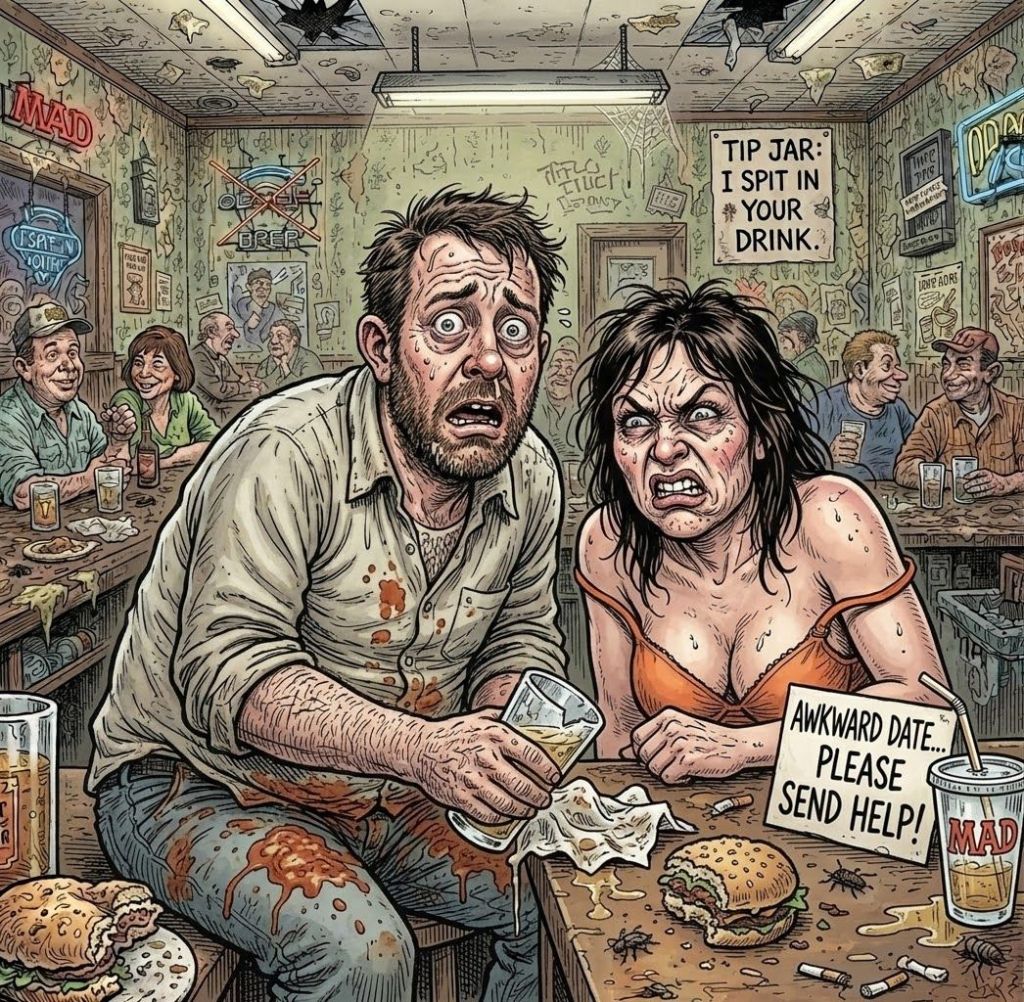
Dating in 2026: Welcome to the Hunger Games of Love
By Relli Calhoun
If aliens landed on Earth tomorrow and their first stop was a dating app, they’d probably assume humans hate each other.
Welcome to dating in 2026, where everyone says they want something “real,” but half the conversations die before someone can even ask, “So, what do you do?” The modern dating scene is less like a romantic comedy and more like customer service—lots of waiting, plenty of disappointment, and every now and then someone leaves you on read for absolutely no reason.
We’ve somehow reached a point where ordering dinner requires more commitment than asking someone out.
Dating apps promised to revolutionize love. Instead, they turned it into online shopping. Swipe left. Swipe right. Add to cart. Remove from cart. “Sorry, this item is no longer available.” Somewhere along the way, people stopped looking for partners and started looking for upgrades.
The biggest lie in modern dating is that having more choices leads to better relationships. It doesn’t. It leads to people believing Prince Charming is just one more swipe away. The result? Nobody waters the grass they’re standing on because they’re convinced the grass on the other side has Wi-Fi, a six-pack, and perfect communication skills.
Spoiler alert: it doesn’t.
Then there’s ghosting—the unofficial national pastime of dating. Once upon a time, breaking up required an uncomfortable conversation. Today, it requires absolutely nothing. One minute you’re planning dinner for Friday, and the next you’re wondering if they joined the witness protection program.
No explanation. No goodbye. Just… gone.
At this point, Casper is probably saying, “That’s a little rude.”
Social media hasn’t helped either. Every couple online looks like they’re starring in a luxury perfume commercial. Matching outfits. Tropical vacations. Candlelit dinners. Slow-motion beach walks. Meanwhile, in real life, they’re arguing over whose turn it is to take out the trash and pretending they didn’t eat the last slice of pizza.
Comparison is poisoning relationships faster than cheating ever could. People scroll through highlight reels and start questioning perfectly healthy relationships because theirs doesn’t look cinematic. News flash: real love isn’t a drone shot over Santorini. Sometimes it’s sitting in sweatpants, splitting takeout, and arguing over what to watch for the next forty-five minutes.
And somehow… that’s beautiful.
Let’s talk about standards.
Everyone wants someone who’s emotionally mature, financially successful, physically attractive, hilarious, loyal, adventurous, spiritually grounded, mentally healthy, family-oriented, six feet tall, owns a home, drinks but not too much, has hobbies but not weird ones, communicates perfectly, and somehow has unlimited free time.
Congratulations. You’ve just described a unicorn with excellent credit.
Here’s the uncomfortable truth: everyone wants perfection while bringing unresolved baggage to the table. We expect flawless partners even though most of us still have notifications from people we swore we’d stop texting three months ago.
Then there’s artificial intelligence. People are now using AI to write bios, craft pickup lines, and even respond to messages. Imagine finally falling for someone only to discover you’ve actually been flirting with a robot that has better grammar than both of you combined.
Technology is supposed to help us connect. Instead, it’s becoming a third wheel.
The funny part is that despite all these apps designed to bring people together, loneliness is still everywhere. We’re connected to thousands of people and somehow feel more disconnected than ever. We know someone’s favorite Netflix show before we know whether they’re kind to waiters.
Maybe we’re collecting information instead of building connection.
But here’s the thing nobody likes admitting.
The apps aren’t entirely the problem.
People are.
We’ve normalized disposable relationships. We avoid difficult conversations. We mistake butterflies for compatibility. We confuse attention with affection and chemistry with character. We chase excitement while overlooking consistency—the very thing that keeps relationships alive after the honeymoon phase disappears.
The healthiest couples usually aren’t the loudest ones online. They’re not making daily relationship videos or posting paragraphs every anniversary. They’re busy living their lives instead of proving they have one.
Funny how that works.
The people finding real relationships in 2026 often have one thing in common: they stop treating dating like a game they’re trying to win. They put the phone down. They meet people through friends, hobbies, church, work, volunteer events, and random conversations that no algorithm could have predicted.
Because despite what Silicon Valley wants us to believe, love has never been downloadable.
At the end of the day, finding someone isn’t the hard part anymore. Keeping someone is.
That takes honesty when lying is easier. Loyalty when temptation is endless. Communication when disappearing only takes one tap. It means choosing one imperfect person in a world constantly advertising someone “better.”
Maybe that’s why real love feels so rare in 2026.
Not because good people no longer exist.
But because commitment has become rebellious.
In a culture addicted to endless options, the boldest thing you can say isn’t “I love you.”
It’s “I’m staying.”
And honestly?
That might be the sexiest sentence left.

